"Rus" may derive from the name of a tribe that gained
political ascendancy in Kiev and other Slavic towns and lent its
name to
the language, culture, and state. Some scholars believe this to
have been
a Varangian (Viking) clan from Scandinavia, and others hold that
it was a
Slavic tribe. Some historians believe that "Rus" derives
from an ancient name for the Volga River.
People ethnically identified as Russians have been politically and
culturally dominant in a vast area for five hundred years of
tsarist and
Soviet imperial expansion. However, despite repression of their
cultural
autonomy, minority cultures have survived within the Russian
Federation;
including the peoples of the North Caucasus, numerous indigenous
groups in
Siberia, the Tatars in the Volga region, and the East Slavic
Ukrainians
and Belorusians. The last three groups are widely dispersed
throughout the
federation. All but the youngest citizens share a Soviet cultural
experience, since under Communist Party rule the state shaped and
controlled daily life and social practice. Much of that experience
is
being rejected by Russians and non-Russians who are reclaiming or
reinventing their ethnic or traditional pasts; many communities
are
asserting a specific local identity in terms of language and
culture.
There is a broad cultural continuity throughout the federation and
among
the millions of Russians in the newly independent republics of
Central
Asia, the Baltic region, and the Caucasus.
Culture of Korea
Korean art possesses several
distinguishing characteristics
that create a unique style of its own. Korean art respects
nature,
and the extensive use of quiet and subdued colors is
manifested
in Korean paintings and ceramics. Humor is another
characteristic
of Korean art. Bold exaggeration, the acceptance of
non-symmetrical
cubic objects, and unique spatial beauty conveyed by
imperfect roundness
are examples of humor in Korean art. Quiet harmony may be
cited
as another characteristic of Korean art. This means that
there is
no excess, the right materials being selected in scale with
the
surroundings. With all of these characteristics, the Korean
arts
have inherited a unique aesthetic sense which depicts beauty
with
honesty and simplicity that is free of artifice.

Koreans traditionally have shown an
intense love
of their land, an emotion felt so strongly that it has been
reflected
in their beliefs, philosophy and religion. The mountains,
rivers,
coasts and seas, and the four seasons that nurture them,
have played
important roles in forming basic thoughts and relationships
among
the people of the peninsula since earliest times. Their
ancestors
migrated across the vast plains from Siberia and Manchuria,
seeking
to find homes in a warmer clime. Settling of their own free
will,
they came to shape a history distinctively their own.
Samgug yusa (Memorabilia of the
Three Kingdoms) records
that it was Tan-gun who founded the nation of Korea. Legend
says
his father, Hwanung, a heavenly deity, decided to settle on
earth
in response to the desire of earthlings. A bear was
transformed
into a woman, and Hwanung married her. Dan-gun was born of
their
union and began a reign in 2333 B.C. that was to continue
for more
than a millennium. While some have dismissed the legend as
an indication
of the totemism of the Korean people, others have noted the
significance
of a belief in which a deity had, of his own volition,
desired to
become a human being. They held that the Korean people did
not consider
the earth a place of exile for heavenly beings, not a place
the
erring were sent to live in penance.
This view was that the land and
country comprised
a dream, so good that even the deities and animals wanted to
live
there, and that the Korean people felt gratified to have
chosen
such a place for their home. Even the neighboring Chinese
were said
to have expressed wonder at the beauty of Korea, summing it
up in
one of their ancient verses: "Would rather live in Korea and
see Mt. Gumgangsan (Diamond Mountain)."

Once known as the "Eastern Land of
Courtesy,"
Korea, in its long history, seldom cultivated overseas
interests,
never invaded its neighbors, nor sought development outside
given
boundaries. Ancient Chinese records say it was the custom of
the
Korean people, being so courteous to each other, to avoid
walking
on the road, fearing it would hamper the movement of
another. Foreigners
commonly were called barbarians.
This excessive adulation of their
homeland, while
being averse to the coveting of the territories of others,
eventually
invited aggression from outside, bringing the subjugation of
the
Korean people and a period of colonial suffering. Among the
many
Korean proverbs is one declaring preference for "an earthly
field of dung to the wonders of the afterworld." This
demonstrates
the choice of the life of the present, no matter how sordid
it may
be, to that of an imaginative, unknown heaven. Korean
literature
contains many tales reflecting such a psychological trend in
thinking.
In traditional literature, a
beautiful lady, called
Seonnyeo, would descend from heaven in search of a fuller
life on
earth, marry an earthling, become a mother and eventually
fulfill
the chores expected of every married woman. She would then
go back
to her former abode in heaven, but there is usually no
reference
to what became of her after her return to heaven.
The art of Korea is different in its
lines and colors,
clearly distinguished from the strong, bold strokes of the
Asian
continent, or from dazzling colorations and excessive
refinement
that mark the art of island nations. On the surface the pale
colors
reflect nothing strong or positive; often they are taken to
have
a negative meaning. Images of willows or clouds are painted
not
in bold, firm lines, but in pale, thin brush strokes. But
these
elements should not lead to a hasty interpretation that
Korea ancestors
were life-weary. The magical effect of these strokes and
lines seem,
at a close look, to reflect the ardent yearning for the life
of
the sonin, the hermit. The heavens, rivers, and other
objects of
nature are rarely painted in strong colors; the pale grayish
colors
have an attraction of their own.

Foreigners who have lived in Korea
and acquired some
knowledge of the Korean language may wonder at the frequent
use
of the phrase, "aigo jukgetda," which literally means
"I could just die." They may also wonder at so many passages
in popular ballads or lyrics in which people vent their
sadness
against the transience of life. One hearing a rendition of
chang,
a style of folk singing, for instance, might even feel it is
a voice
crying in agony. Hearing and reading Korean songs and
writings,
foreigners may raise the question whether this is not the
true characteristic
of the people. This negative outlook on life was caused by
the decline
in the power of the state in succeeding chapters of history,
and
made all the more bitter by subsequent foreign invasions of
Korea.
These views have now given way to
the newly resurging
vitality of youthful Koreans who want no more of this
nihilistic
attitude. No matter how much they "want to die," they
ardently desire a good life on this earth. One proof of this
way
of thinking might be found in the way children are named in
Korea.
Many names take the meaning of stone and iron, such as
Chadori or
Soedori. Stone and iron are ageless, hard and able to
withstand
the test of time. These names are given in the hope of
bestowing
long life on the bearers. Koreans have a flair for
decorating things
with Chinese ideographs, the most common being su, meaning
long
life, and bok, bliss. Of these two characters, preference is
for
the former. First is long life, and then well-being. The two
letters
are always read su-bok and not bok-su. Wealth, a good
career, health,
and many children are considered factors of bliss.
In building a house or choosing a
place for burial,
Koreans have always considered the natural surroundings,
such as
the course of a river or shape of a mountain, important.
There were
criteria for choosing the most ideal place, which went by
the name
myongdang. Large amounts of money were often spent for the
purpose
of selecting a myongdang by means of geomancy. Without
exception,
powerful families concentrated their attention on securing
such
places for residences and burial grounds, not to speak of
royal
palaces and royal tombs. This observance of geomancy is
evident
in numerous graves that dot the Korean countryside. This
practice
flourished during the Goryu and joseon periods.
Heaven has always been considered
the source of both
mercy and wrath. Periodic rituals with offerings to heaven
were
conducted for the benefit of farmers and fishermen.
Believing in
the power of heaven over the destiny of mankind, they prayed
for
bumper crops or safe voyages. Among the many exclamations in
Korea
are two which concern the subject of heaven: "Heaven"
is shouted when some extraordinary emergency arises, and
"learn
to fear heaven" is uttered when someone does something
unacceptable.
Heaven was respected because of its vastness and light; it
was neither
a religious worship, nor a traditional folk custom. It was
for this
reason that human dignity was often associated with heaven.
For
example, a king was a "son of heaven." This creed eventually
produced the Donghak philosophy or Eastern Learning in the
late
19th century, the essential concept of which equated the
power of
heaven with that of man.
There seems to be no single concept
as far as the
philosophy of Korea is concerned. Just as the life of a
Korean could
hardly be divorced from the currents of the world, so with
philosophic
tenets. Korean philosophy has progressed and became enriched
through
meetings, conflicts, and combinations with alien thoughts.
At certain
stages in history, Koreans learned to combine their own
inherent
philosophies with those of other countries. This process
often produced
a brilliant synthesis, disclosing the imaginative power and
creative
sense of Koreans. Thus, foreign philosophy as well
benefitted from
Korean influence.
Koreans rarely indulged in
discussing abstract matters,
for their interest was focused on the present. Some, of
course,
did theorize and brought forth solid philosophic theses, but
always
these were accompanied by calls for actual practice.
Apparently
the ancient sage did not stroll amid beautiful scenery, lost
in
meditation over abstract escapist thought. To many of them,
it was
important that their thoughts help cultivate their
personality.
The principles which guided members of the Hwarang corps
during
the Silla kingdom included matching body with mind, and
matching
word with action. It was a demonstration of true Korean
philosophy.
Through the expounding of Buddhism, theorizing upon
Confucianism,
and showing reverence for heaven and all the spirits that
inhabit
nature's creatures, Koreans shaped their philosophy.
Culture of Japan
The name "Yamato" is used by archaeologists and historians
to distinguish Japanese artistic genres from their Chinese
counterparts.
When used as a contemporary term, Yamato has strong associations
with the
imperial system, and thus with conservative nationalist
ideologies.
Contemporary Japan is considered a highly homogeneous society, but regional variation in social and cultural patterns has always been significant. Pride of place and identification with local cultural patterns remain strong. Japanese people often attribute personality traits to people from particular regions, and regional identity often is expressed through local culinary specialties and dialects.
The Japanese archipelago consists of four major islands and over six-thousand minor ones, covering approximately 234,890 square miles (378,000 square kilometers), and has enormous climatic variation. The four major islands are Hokkaidō, Honshū, Shikoku, and Kyūshū. The southern island group of Okinawa (the Ryūkyū Islands) is geographically, historically, and culturally distinct. Japan faces the Pacific Ocean along the entire eastern and southern coastline. To the north and west are the Sea of Okhotsk, the Sea of Japan, and the East China Sea. The Korean peninsula is the closest point on the Asian mainland. Japanese life has always been oriented toward the ocean. The currents that converge offshore create fertile and varied fishing grounds.
The climate is shaped by Asian-Pacific monsoon cycles, which bring heavy rains from the Pacific during the summer and fall, followed by icy winds from North Asia during the winter that dump snow in the mountains.
There are approximately 1,500 volcanoes, and because the islands lie on major fault lines, earthquakes are common occurrences. Only about 15 percent of the land is level enough for agriculture, and so the population density in coastal plains and valleys is extremely high. Because of the steep mountains, there are almost no navigable inland waterways.
Contemporary Japan is considered a highly homogeneous society, but regional variation in social and cultural patterns has always been significant. Pride of place and identification with local cultural patterns remain strong. Japanese people often attribute personality traits to people from particular regions, and regional identity often is expressed through local culinary specialties and dialects.
The Japanese archipelago consists of four major islands and over six-thousand minor ones, covering approximately 234,890 square miles (378,000 square kilometers), and has enormous climatic variation. The four major islands are Hokkaidō, Honshū, Shikoku, and Kyūshū. The southern island group of Okinawa (the Ryūkyū Islands) is geographically, historically, and culturally distinct. Japan faces the Pacific Ocean along the entire eastern and southern coastline. To the north and west are the Sea of Okhotsk, the Sea of Japan, and the East China Sea. The Korean peninsula is the closest point on the Asian mainland. Japanese life has always been oriented toward the ocean. The currents that converge offshore create fertile and varied fishing grounds.
The climate is shaped by Asian-Pacific monsoon cycles, which bring heavy rains from the Pacific during the summer and fall, followed by icy winds from North Asia during the winter that dump snow in the mountains.
There are approximately 1,500 volcanoes, and because the islands lie on major fault lines, earthquakes are common occurrences. Only about 15 percent of the land is level enough for agriculture, and so the population density in coastal plains and valleys is extremely high. Because of the steep mountains, there are almost no navigable inland waterways.
The population in 1999 was 127,000,000. The country is heavily
urbanized,
and urban areas have extremely high population densities.
According to the
1995 census, 81 million people (65 percent) live in urban areas;
that
constitutes only 3 percent of the land area.
During the last 150 years of industrialization and economic
development,
the population has grown from around thirty million to its present
size.
This increase occurred as a result of a rapid demographic
transition
characterized by an enormous movement of people from rural to
urban areas,
dramatic decreases in infant mortality, increases in longevity,
widespread
reliance on birth control, and transformations of family
composition from
large, multigenerational extended households to small nuclear
families.
Life expectancy is the highest in the world, and the birthrate has been declining dramatically. Because of these trends, the population is projected to peak early in the twenty-first century and then shrink.
Culture of Indonesia
The Republic of Indonesia, the world's fourth most populous
nation, has 203 million people living on nearly one thousand
permanently
settled islands. Some two-to-three hundred ethnic groups with
their own
languages and dialects range in population from the Javanese
(about 70
million) and Sundanese (about 30 million) on Java, to peoples
numbering in
the thousands on remote islands. The nature of Indonesian national
culture
is somewhat analogous to that of India—multicultural, rooted in
older societies and interethnic relations, and developed in
twentieth
century nationalist struggles against a European imperialism that
nonetheless forged that nation and many of its institutions. The
national
culture is most easily observed in cities but aspects of it now
reach into
the countryside as well. Indonesia's borders are those of the
Netherlands East Indies, which was fully formed at the beginning
of the
twentieth century, though Dutch imperialism began early in the
seventeenth
century. Indonesian culture has historical roots, institutions,
customs,
values, and beliefs that many of its people share, but it is also a
work
in progress that is undergoing particular stresses at the
beginning of the
twenty-first century.
The name Indonesia, meaning Indian Islands, was coined by an Englishman, J. R. Logan, in Malaya in 1850. Derived from the Greek, Indos (India) and nesos (island), it has parallels in Melanesia, "black islands"; Micronesia, "small islands"; and Polynesia, "many islands." A German geographer, Adolf Bastian, used it in the title of his book, Indonesien , in 1884, and in 1928 nationalists adopted it as the name of their hoped-for nation.
Most islands are multiethnic, with large and small groups forming geographical enclaves. Towns within such enclaves include the dominant ethnic group and some members of immigrant groups. Large cities may consist of many ethnic groups; some cities have a dominant majority. Regions, such as West Sumatra or South Sulawesi, have developed over centuries through the interaction of geography (such as rivers, ports, plains, and mountains), historical interaction of peoples, and political-administrative policies. Some, such as North Sumatra, South Sulawesi, and East Java are ethnically mixed to varying degrees; others such as West Sumatra, Bali, and Aceh are more homogeneous. Some regions, such as South Sumatra, South Kalimantan, and South Sulawesi, share a long-term Malayo-Muslim coastal influence that gives them similar cultural features, from arts and dress to political and class stratification to religion. Upland or upriver peoples in these regions have different social, cultural, and religious orientations, but may feel themselves or be perforce a part of that region. Many such regions have become government provinces, as are the latter three above. Others, such as Bali, have not.
The name Indonesia, meaning Indian Islands, was coined by an Englishman, J. R. Logan, in Malaya in 1850. Derived from the Greek, Indos (India) and nesos (island), it has parallels in Melanesia, "black islands"; Micronesia, "small islands"; and Polynesia, "many islands." A German geographer, Adolf Bastian, used it in the title of his book, Indonesien , in 1884, and in 1928 nationalists adopted it as the name of their hoped-for nation.
Most islands are multiethnic, with large and small groups forming geographical enclaves. Towns within such enclaves include the dominant ethnic group and some members of immigrant groups. Large cities may consist of many ethnic groups; some cities have a dominant majority. Regions, such as West Sumatra or South Sulawesi, have developed over centuries through the interaction of geography (such as rivers, ports, plains, and mountains), historical interaction of peoples, and political-administrative policies. Some, such as North Sumatra, South Sulawesi, and East Java are ethnically mixed to varying degrees; others such as West Sumatra, Bali, and Aceh are more homogeneous. Some regions, such as South Sumatra, South Kalimantan, and South Sulawesi, share a long-term Malayo-Muslim coastal influence that gives them similar cultural features, from arts and dress to political and class stratification to religion. Upland or upriver peoples in these regions have different social, cultural, and religious orientations, but may feel themselves or be perforce a part of that region. Many such regions have become government provinces, as are the latter three above. Others, such as Bali, have not.
Culture of France
French national identity is based on the historical origins of
the nation
in Celtic, Gallo-Roman, and Frankish cultures. The name
"France" originally was used to refer to several peoples in
the lower Rhineland. It gradually was introduced as a more
widespread term
to denote that territory, formerly known as Gaul, after the
Frankish
invasion and the retreat of the Romans. The name "Francia"
was applied to various territorial units until the Middle Ages,
when it
came to signify the kingdom of the French sovereign. Regional
identities,
such as Provencal and Breton have coexisted with political units
of state
control. The degree to which France is today a homogeneous nation
is a
highly contested topic. Political and linguistic unification,
especially
through mass education, has been an ongoing project of
nationalism. The
immigrant population comes mainly from Portugal and northern
Africa,
although there has been increasing immigration from eastern
Europe. France
takes a highly assimilationist approach to its immigrant
populations. The
social position of
Beurs
(the children of North African immigrants) is an ongoing issue.
The
population is divided by social class, political party
affiliation,
generation, ethnicity, and region. Having had a significant rural
population well into the twentieth century, the country continues
to be
marked by a rural-urban split.
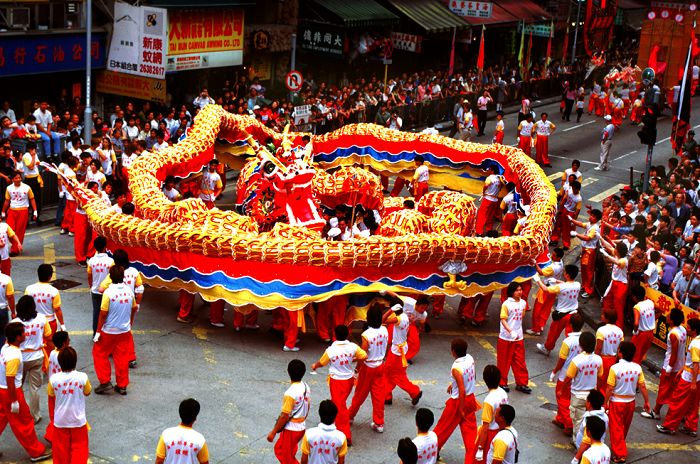
Chinese Dragon Dance
One of the highlights of the celebration is the spectacular
Dragon Dance.
It's history goes back to
the (180 - 230 CE) in ancient China. The Chinese have
always
perceived the dragon as being sacred and possessing power, courage,
righteousness, dignity, fertility, wisdom, and auspiciousness.
festivities celebrate the outset of the planting season in China. The dragon represents rain and good fortune, elements crucial for the agricultural crops. This mythical beast takes the physical form of many animals; it has the horns of a stag, the ears of a bull, the eyes of a rabbit, the claws of a tiger, and the scales of a fish distributed along the body of a long serpent. It was believed these combined traits allowed the creature to walk on land, fly through the heavens, and swim through the waters. These powers gives the dragon the authority to rule the clouds and to control the rain.
The Dragon Dance requires the coordinated efforts of a team of dancers who come from martial arts groups. The dragon consists of a head mask and a lengthy body which is held up with poles and transported by the dancers. The lead dancer holding the dragon's head has an extremely important job. He or she makes the dragon twist, leap, crouch, and dip, as sinuous as a snake.
The dragon mask itself, usually colored red, green, or gold, is gorgeous and very complex in design. Sometimes the head has animation and pyrotechnics that belch smoke. The number of body sections can vary, sometimes using as many as 25 sections divided by hoops of bamboo. The longer the dragon, the more good fortune.
The dragon is difficult to manipulate and requires well-trained dancers in top physical condition. The creature moves in precise patterns to the music provided by drums, cymbals, and a gong. Onlookers throw firecrackers at the dancing dragon's feet to scare away any evil spirits and also to assure the beast is fully awake from its hibernation.
The color green on the dragon stands for an extraordinary harvest, yellow is for the solemn empire, prosperity is represented by gold or silver, red is excitement, and the dragon's scales and tail are a shimmering silver symbolizing joy.
At times, at larger celebrations, a spectator might see a Double Dragon Dance where two groups of dancers intertwine their dragons in intricate patterns. A truly rare performance involves nine dragons (Kawlung) because nine is a perfect number. However, such performances necessitate the coordinated efforts of several dance troupe.
Hopefully, visitors to Chinatown will have the opportunity to observe the breathtaking, astounding Dragon Dance.
festivities celebrate the outset of the planting season in China. The dragon represents rain and good fortune, elements crucial for the agricultural crops. This mythical beast takes the physical form of many animals; it has the horns of a stag, the ears of a bull, the eyes of a rabbit, the claws of a tiger, and the scales of a fish distributed along the body of a long serpent. It was believed these combined traits allowed the creature to walk on land, fly through the heavens, and swim through the waters. These powers gives the dragon the authority to rule the clouds and to control the rain.
The Dragon Dance requires the coordinated efforts of a team of dancers who come from martial arts groups. The dragon consists of a head mask and a lengthy body which is held up with poles and transported by the dancers. The lead dancer holding the dragon's head has an extremely important job. He or she makes the dragon twist, leap, crouch, and dip, as sinuous as a snake.
The dragon mask itself, usually colored red, green, or gold, is gorgeous and very complex in design. Sometimes the head has animation and pyrotechnics that belch smoke. The number of body sections can vary, sometimes using as many as 25 sections divided by hoops of bamboo. The longer the dragon, the more good fortune.
The dragon is difficult to manipulate and requires well-trained dancers in top physical condition. The creature moves in precise patterns to the music provided by drums, cymbals, and a gong. Onlookers throw firecrackers at the dancing dragon's feet to scare away any evil spirits and also to assure the beast is fully awake from its hibernation.
The color green on the dragon stands for an extraordinary harvest, yellow is for the solemn empire, prosperity is represented by gold or silver, red is excitement, and the dragon's scales and tail are a shimmering silver symbolizing joy.
At times, at larger celebrations, a spectator might see a Double Dragon Dance where two groups of dancers intertwine their dragons in intricate patterns. A truly rare performance involves nine dragons (Kawlung) because nine is a perfect number. However, such performances necessitate the coordinated efforts of several dance troupe.
Hopefully, visitors to Chinatown will have the opportunity to observe the breathtaking, astounding Dragon Dance.
Balinese Culture
Balinese culture is a unique combination of spirituality,
religion, tradition and art.
Religion is considered to be art and it seems that almost every Balinese
is a devoted artist, spending 'free time'
applying skills and images which have been passed down from
generation to generation and grasped from a very young age.
Expressed through beautiful and intricate paintings, extraordinary
carvings, superb weaving, and even in rice decorations
that cover the myriad shrines found in public areas, in paddy fields
or in homes, the island is alive with art and religious
homage.
Sekala and Niskala
Balinese culture is a complex event characterised by diversity and adaptability. A central dictum in Balinese thinking is the concept of Desa - Kala - Patra, (time, place and situation), a dynamic notion holding that traditional thinking will blend in harmony with the new. The Balinese distinguish between Sekala, the material, and Niskala the eternal. Reality is a coincidence of the material and the eternal realms. One does not exist without the other. The world, therefore, is the product of the interaction of Sekala and Niskala.Temple Festivals
Temple festivals are commonplace. Each village will hold some sort of colourful ceremony for each one of its own temples a couple of times a year. Add to this the rituals and celebrations for each persons' passage from birth, puberty, marriage, childbirth to death and the after-world, and include the major island-wide celebrations like Galungan, Kuningan and Nyepi; the day of silence when the whole island closes down in fear of evil spirits flying in from the sea, and you can begin to understand how important religion in Bali is.Hindu Dharma
Art, culture and day to day activities for most Balinese are strongly bonded to a unique form of Hinduism called Hindu Dharma, which is widely thought to be the closest example to the religion and social framework that existed in Java during the zenith of its power and is now found nowhere else. Classical dance dramas based on the old Hindu epics of the Ramayana and the Mahabarata which arrived from Java, are like everywhere else in Indonesia, mixed with pre-Hindu animist belief and peculiar local folklore. Not all Balinese adopted the new Hindu religion though. The Bali Aga who now live in isolated groups in the mountains at Trunyan and Tenganan, for example, preferred their ancient animist beliefs, which are still practiced and remain largely intact today.Balinese belief systems
The very soul of Bali and Balinese belief systems is rooted in religion and is expressed in art forms and skills that have been passionately preserved over the centuries. During the mid sixteenth century Bali reached a cultural climax, which encouraged and developed elaborate arts and customs, which are the foundations of what is practiced today. In a sense they have changed very little since that time, but as has been the case throughout much of the Indonesian archipelago, adaptation of new environments is absolutely essential for survival. It was at this time that the Javanese Hindu and the Balinese calendars were combined and a complex schedule of rituals and ceremonies was defined. Nine great temples, the Pura Agung, were also built, linking the structure of the new calendar with that of the gods. The most sacred being the Mother Temple, Pura Besakih, built high on the slopes of Bali 's most sacred mountain, Gunung Agung.
Langganan:
Postingan (Atom)